Manifesto, a six-minute read
What the drawing leaves out
On an aluminium frame and the thinking that went into it.
Lucas Kuijper, Eindhoven, November 2026
Act I
What is on the bench
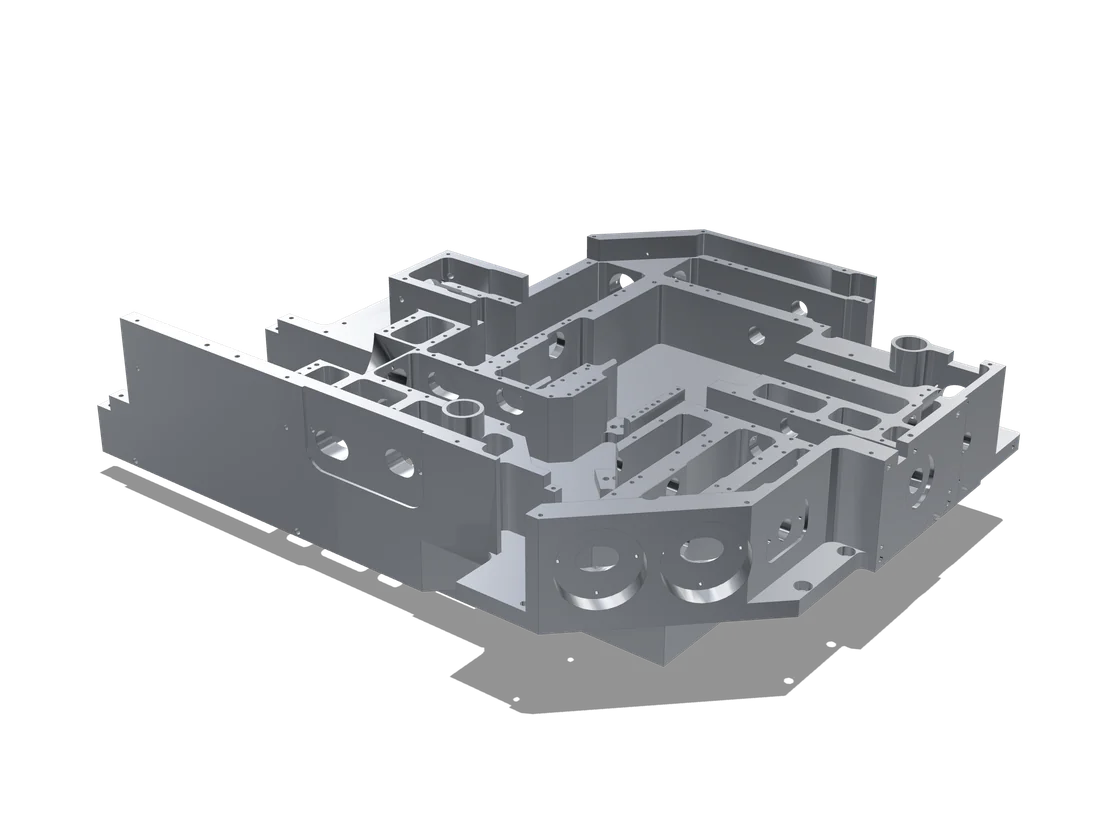
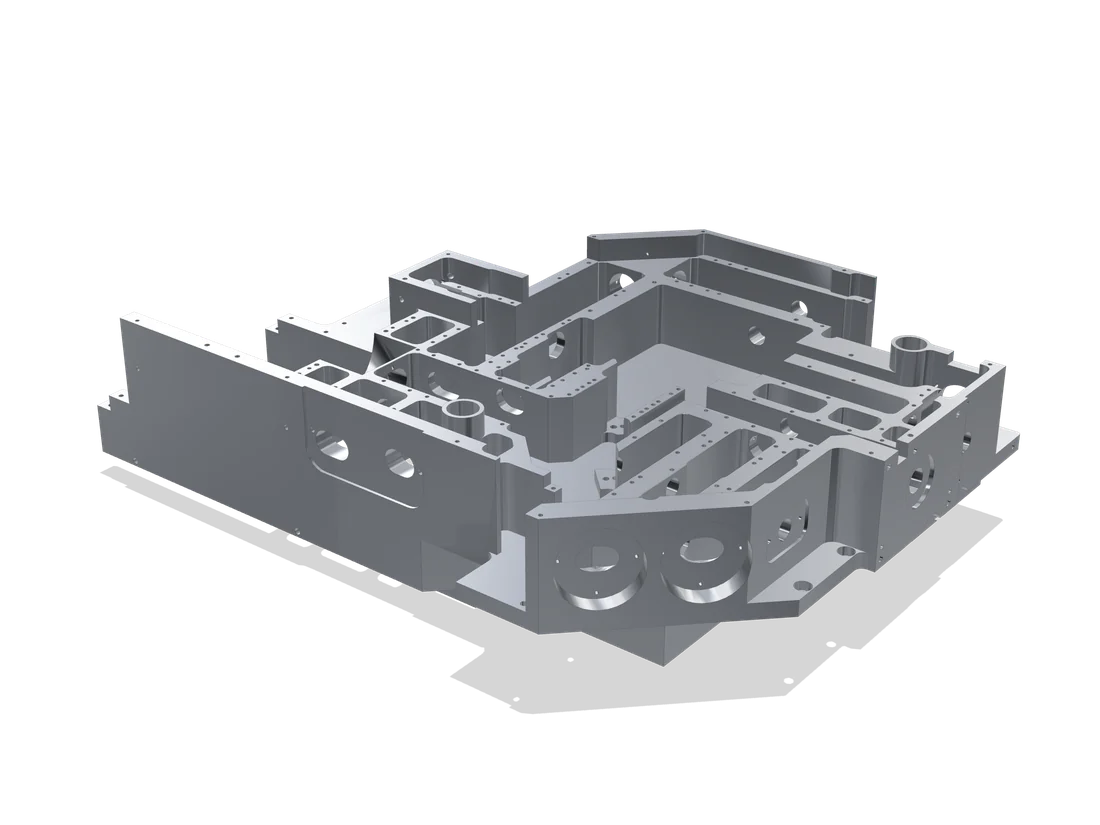
On the bench lies a frame of bare aluminium. Almost forty centimetres by thirty, just under ten tall, and lighter than it looks: most of the metal it started as is in the chip bin beside it. What is left is walls, pockets and more holes than you can count at a glance. Next week it will be black.
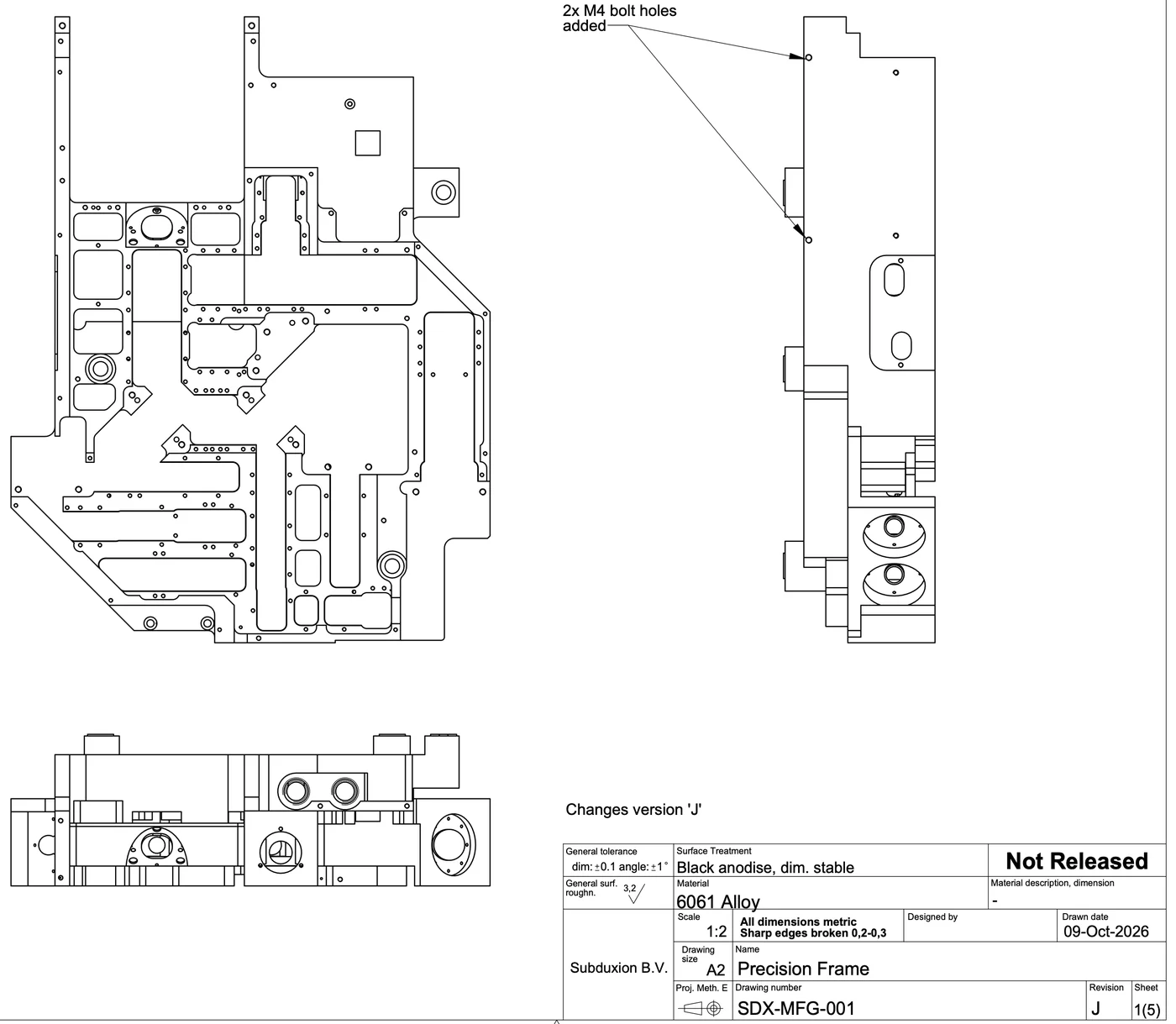
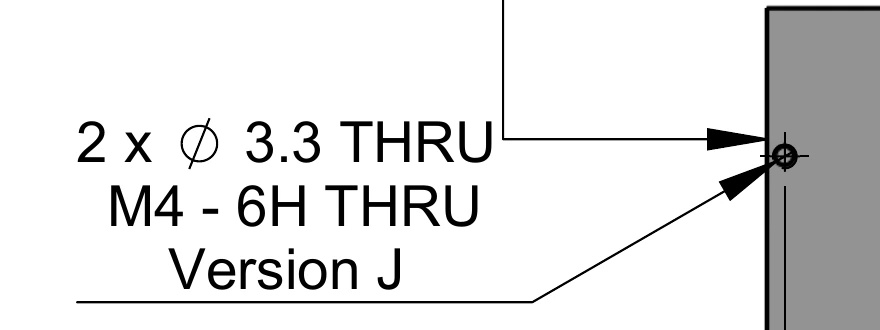
Put the drawing next to it. Sheet 1 of 5: 6061, general tolerance ±0.1, Ra 3.2, black anodise, dimensionally stable. The title block says revision J and, in large letters, Not Released. A note in the side view points to two added M4 holes. On the screen behind it sits the 3D model, exact down to every face. In it, an M4 is a 3.3 mm hole; the thread exists only on the drawing.
- 6061, no temper stated
- ±0.1, angle ±1°
- Black anodise, dimensionally stable
- Revision J, Not Released
Which face goes down on the table first is in neither.
| Item | Drawing | 3D model |
|---|---|---|
| Shape | in views | exact, down to every face |
| M4 holes | M4‑6H thru | Ø3.3 mm hole |
| Which face goes down first | not stated | not stated |
Someone filled that gap: in one shop the process planner, in another the cost engineer, in a small shop often the owner. It began when someone picked up the drawing and went quiet for a while.
First, the size: ±0.1 over almost forty centimetres, with thin walls. Take most of a block away and the residual stress in what is left finds a new balance; the part moves. How far depends on the temper of the 6061, and the drawing does not say. So rough with stock left on, release the clamps, let it settle, and only then finish to size.
Then the holes in the side walls: on a three-axis machine, a setup per wall on an angle plate; on the five-axis, tilted in the same clamping, as long as the clamping leaves the walls free. Then the thread: will a 6H gauge still go in after anodising, or do the holes need plugging or an oversize tap? And the shop itself: which machine holds the size, which one frees up next week, and whether it is one piece or fifty. At one piece, the programming outweighs the cutting.
Only then did a time go down on paper, and a number on the quote.
The buyer who gets the quote sees a price and a lead time. That someone, between two other requests, weighed an angle plate against a five-axis machine is nowhere on it.
Act II
Where the reasoning goes
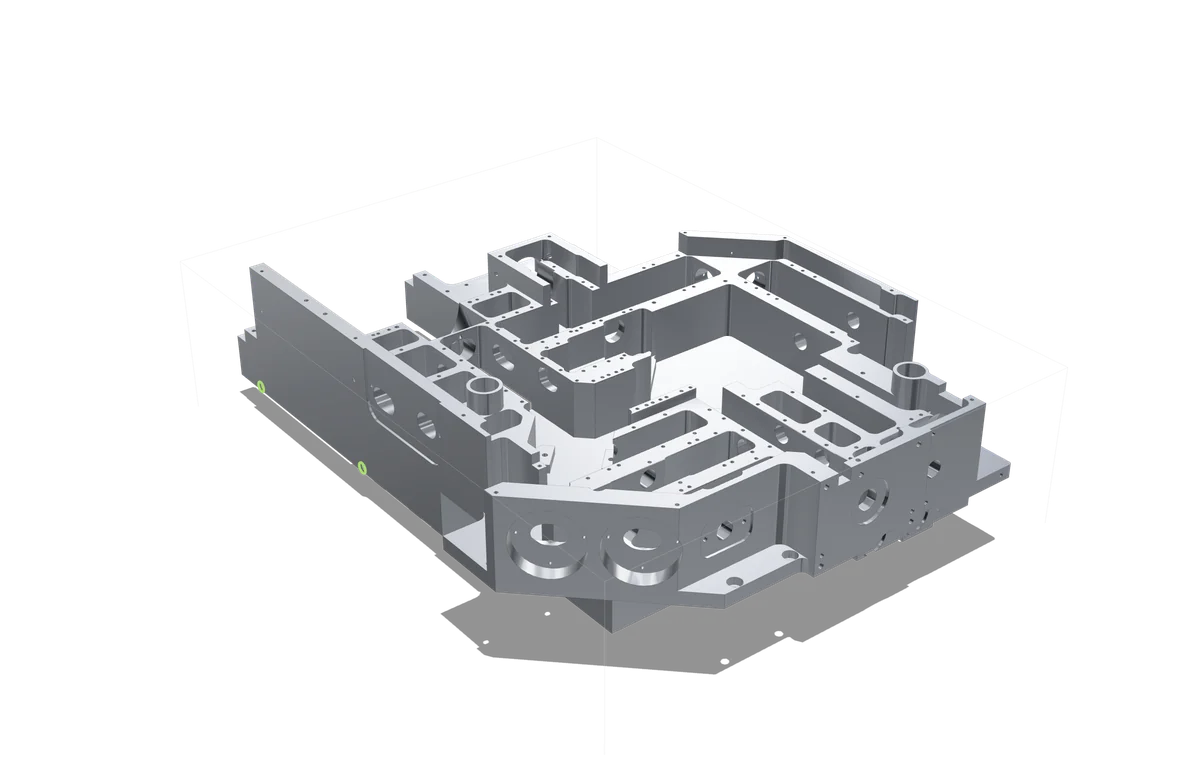
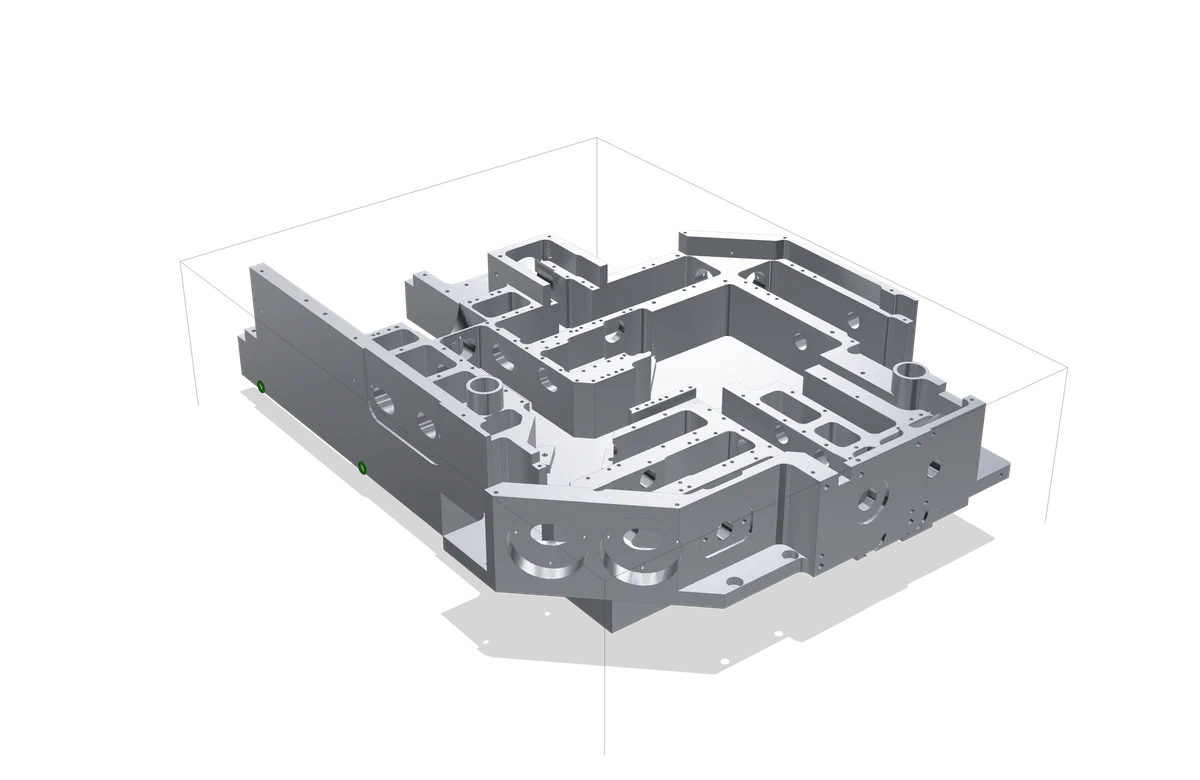
The frame goes to the anodiser and then to the customer. What stays behind is scattered: the drawing in a folder, the NC program in the control, the estimate in a spreadsheet, the arrangement with the anodiser in an email. The setup sheet at the machine has a photo of the angle plate, but not why it had to be there. That is in someone's head.
CAD, CAM and the ERP each do their job, and a five-axis machine now reaches those side walls without an angle plate. But the reasoning that tied one to the other has a fixed home in none of them.
The only thing still holding all those decisions together is the frame itself, and it has gone out the door.
Suppose it comes back in eighteen months as revision K, with two holes moved. Whoever prepared it is on something else now. The program cannot tell you whether that angle plate was a deliberate choice or a workaround because the five-axis was booked that week, nor whether a moved hole now sits under a clamp. So the old program is edited or the old number copied. Usually that works out, but the why is either worked out again or quietly assumed, and either way nothing records what was weighed back then.
Whoever knows the trade best gets the hardest requests, and so is not only the expert but also a translator between drawing and machine, a courier between systems and the company's memory. None of those last three is in the job description.
Give the same drawing to two good planners and you may get two routes back, with two different numbers. Both defensible. Only one gets made, and why the other chose differently is written down nowhere.
So a shop makes good decisions every day that it can reuse only as long as nothing changes. A choice that is written down nowhere cannot be set against its outcome either. The knowledge is there. It just does not build up.
Act III
What stays when the part has gone
- M4-6H, confirmed
- Setups, recorded by you
- Black anodise, outsourced
I'm from Eindhoven. I once had a side job at a metal machining shop and came into contact with the high-tech world in the region. At Subduxion we are building Blake for the people at shops like that who pick up the drawing.
The starting point is that everything about this frame stays together: model, drawing, requirements, operations, setups, your machines and rates, and what it costs. Today it travels on as an export; we will keep building until nobody further down the line has to work out again what was already weighed at quote time.
We start with calculation and quoting, because that is where every request begins. For this frame, the drawing's requirements, from the 6061 to the M4 thread and the black anodise, arrive as proposals you confirm or correct, and you record the setups yourself. If the anodiser's price is not yet known, that line stays open and never becomes zero. What comes out, per piece and per batch, is called what it is: an estimate.
The next step is software that proposes how a part can be made, checks routes against your machines, your workholding and your rates, and keeps the reasoning with the result. When the frame comes back as revision K, it should be able to show what changed and which earlier choice that unsettles. That way a decision would no longer vanish when the quote goes out, the drawing gets a new letter or the spindle stops.
Where the work repeats and the result is demonstrably right, the software will prepare it on its own. You come in where a choice has consequences, like that angle plate, with the reasoning ready when you ask for it. Afterwards nobody needs to retype that choice or retell it.
Further out lies research: not the hours booked to an order, but what the machine actually did in each operation and how long it took, measured reliably and set against the prediction. Where the two part ways there is something to learn, but no adjustment takes effect quietly: someone who knows the trade decides whether it counts. Software that corrects itself like this does not exist yet. We will build towards it as far as the evidence reaches.
By now the frame is with the customer. What is already kept about it today: the setups, every correction to the calculation with its reason and the number on the quote. So a colleague a year from now can still see why it was decided that way. Whoever picks up revision K after you may go quiet for a while too. But first they will read what you recorded.